Cooling Tower Applied in Pharmaceutical Manufacturing
Cooling systems in pharmaceutical manufacturing usually sound like something “secondary” in the whole process, but anyone familiar with pharma production knows that stable cooling actually sits at the center of process reliability. In this particular project, our team supplied a
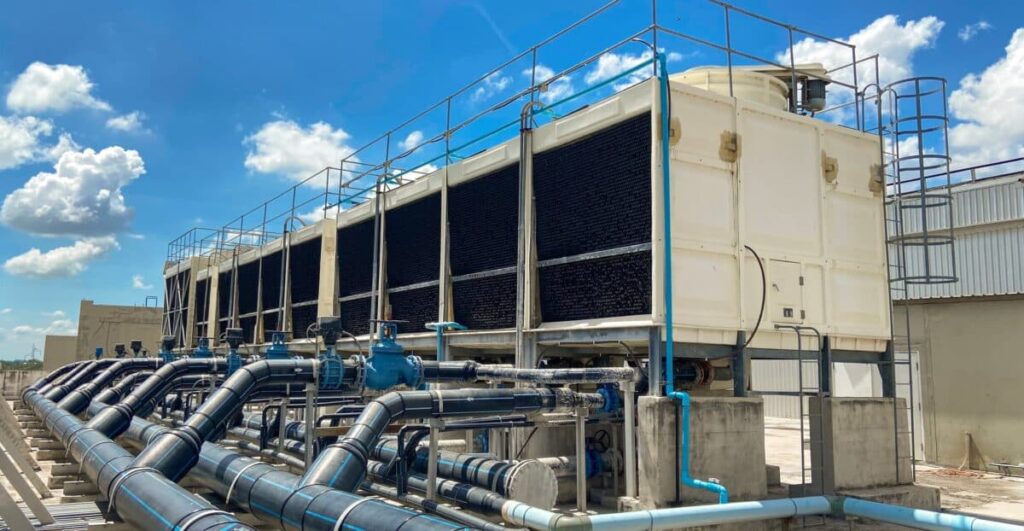
Cross Flow Open Cooling Tower to a pharmaceutical plant producing both intermediates and finished dosage forms. What seemed like a simple equipment upgrade turned out to be a valuable lesson in how cooling performance affects compliance, batch stability, and overall production efficiency.
View our Open Cooling Tower solutions
Why This Pharmaceutical Client Needed a Change
Before contacting us, the client had been operating an older cooling tower system that often produced inconsistent return-water temperatures—sometimes only 1 or 2°C fluctuations, but in pharma manufacturing this small difference can influence reaction stages, fermentation cycles or solvent recovery processes. Several times per month the plant had to slow down parts of the operation simply because the cooling performance wasn’t steady enough.
During the early conversations, the client only described the issue as: “We need something more stable, and easier for our engineers to maintain.”
But after on-site inspection, the real situation became clearer: the older unit had uneven water distribution, scale buildup, drifting water droplets, and a fan speed control system that was too primitive for their temperature-sensitive operations.

Why the Cross Flow Open-Type Tower Was Selected
Although both cross-flow and counter-flow towers are used in industrial facilities, the cross flow design had several advantages particularly suitable for pharmaceutical environments:
- Easy access for inspection — The side-entry layout allows technicians to check the fill, drift eliminators and distribution basins without dismantling too much. This convenience is a big deal under GMP guidelines where equipment must be regularly inspected and documented.
- Lower noise — Many pharmaceutical factories have cleanrooms, laboratories or office blocks near utility areas. A lower-noise fan is a direct operational benefit.
- Smoother water distribution — This becomes important when maintaining stable cooling water supply during long production cycles.
- Greater compatibility with water treatment systems — Since pharma plants are strict about microbial control, an easily serviceable design is a much better fit.
See Cross Flow Tower Specifications
Customized Adjustments for This Project
After evaluating the heat load and the plant’s plan for future expansion, we configured a mid-size cross-flow tower but with several customized modifications. These included:
- Upgraded stainless steel drift eliminators to reduce drift rate and keep water cleanliness consistent.
- Reinforced FRP structure due to local climate and seasonal high winds.
- Additional inspection doors because the client needed easier access for routine validation tasks under GMP.
- High-efficiency fill packs that achieve more heat transfer while reducing resistance.
- VFD-controlled fan system to stabilize water temperature and lower energy consumption.
While none of these changes seem dramatic on the surface, they all combine to meet the pharmaceutical manufacturing environment where reliability, repeatability, and maintenance transparency are essential parts of compliance.
What Happened After Commissioning?
Interestingly, this is one of those cases where results showed up almost immediately. During the first high-load weeks of production, the cooling tower maintained stable cold water temperatures even during midday peaks. The operations team reported that they no longer saw the irregular temperature “jumps” they were struggling with before.
The maintenance department also noted that they spent noticeably less time on cleaning and inspections—roughly a 30% reduction. Because the cross-flow design allows direct access to fill and basins, the cleaning cycle became faster and more predictable.
An Unexpected Bonus: Energy Savings
What surprised the client most was the energy data. With the variable-frequency fan control, the tower rarely operated above 70% load. Most of the time, it stayed around 50–60%, meaning substantial energy savings.
Their internal report suggested that the new system consumed 12–16% less electricity over a full month of operation. This was not the main goal at the beginning, but it quickly became one of the most appreciated improvements.
Why VFD Control Matters for Cooling Towers
Lessons Learned from This Installation
Every project leaves behind something worth noting. For pharmaceutical clients, these few points may be even more relevant:
- Temperature stability is not the only metric. Inspection convenience and system transparency matter just as much under GMP.
- The best cooling tower is the one that fits the workflow. Pharma production is sensitive, and even short temperature variations can influence entire batches.
- Cross flow towers are especially suitable where regular cleaning or validation is required.
This case demonstrated that choosing the right cooling tower is not about selecting the largest capacity or the lowest upfront price. It’s about matching equipment capability with industry standards and operational expectations.
Conclusion
Today, the system has been running for months with consistently positive feedback. Temperature control is more stable, maintenance time is shorter, and operational noise is reduced. For a pharmaceutical plant where consistency and compliance drive every decision, the cross-flow open cooling tower proved to be a reliable long-term solution.
If your factory is facing issues such as unstable cooling water, high energy consumption, or maintenance difficulties, feel free to reach out. We can provide industry-specific recommendations based on years of experience across pharmaceutical, chemical, food processing and HVAC fields.